Plan Change 120 and the East Coast Bays: what it actually means for your street

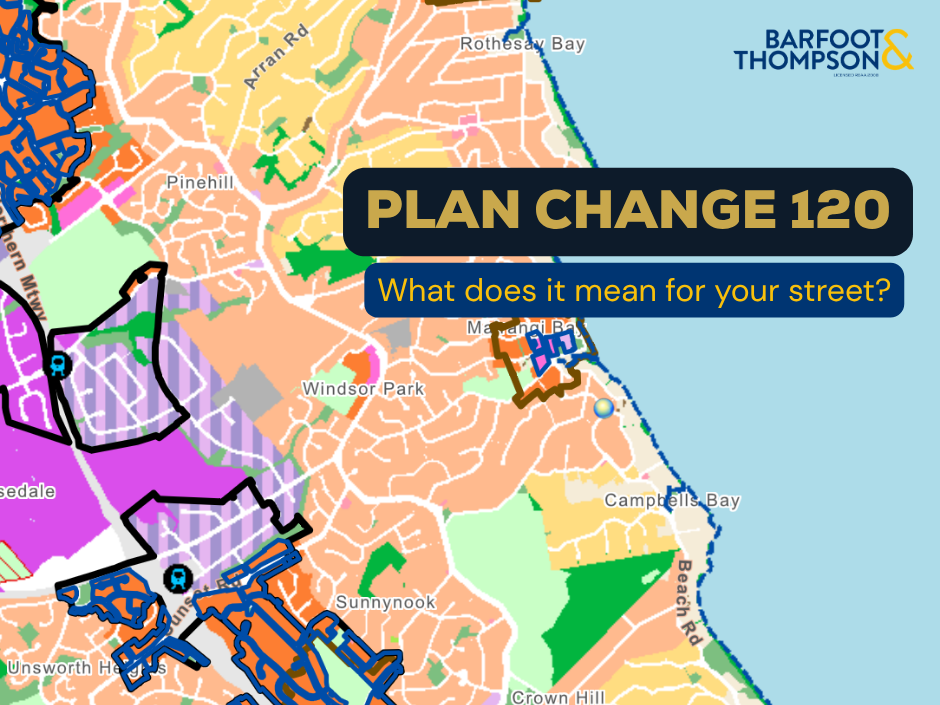
If you own a home in the East Coast Bays, Plan Change 120 is the Auckland Council proposal that will shape what can be built next to you for the next thirty years.
The national headlines talk about taller buildings and millions of new homes. On most streets in Mairangi Bay, Murrays Bay, Campbells Bay, Rothesay Bay and Windsor Park, the reality is close to the opposite. Here is the plain version, so you can check it for yourself.
PC78 vs PC120: what is changing
Plan Change 120 replaces an earlier plan, PC78. Auckland Council withdrew PC78 in October 2025 and notified PC120 in its place. The simplest way to understand the shift is side by side.
PC78 (the old plan, now withdrawn) | PC120 (proposed now) | |
The core idea | One blanket rule across the whole city | Targeted density where transport and centres already are |
A standard residential site | Three homes up to three storeys as of right, no consent needed, on most sites | Blanket right removed, what you can build depends on location |
Tall buildings | Three storeys spread across most suburbs | Height concentrated near rapid transit and centres, up to 15 storeys by the City Rail Link stations |
Flood and coastal hazard land | Council could not stop intensification, even on floodplains | Stronger rules, worst-affected sites down-zoned toward single house |
Citywide capacity (theoretical) | About 2 million homes | 1.4 million minimum, around 1.6 million still likely enabled |
The East Coast Bays | Broad upzoning across the Bays | Hibiscus and Bays takes the city's biggest cut, about 46,600 fewer homes |
Where it stands | Withdrawn, October 2025 | Live, a second submission round is coming before final decisions in mid-2027 |
The short version is this. PC78 applied one blanket rule to almost every street in Auckland, the Medium Density Residential Standards, which allowed three dwellings up to three storeys on most sites without resource consent. PC120 removes that blanket right and points density at the places that already have the transport and the town centres to carry it. For the East Coast Bays, that means less blanket intensification, not more.
Plan Change 120 in the East Coast Bays: stats at a glance
Measure | Figure | Source |
Citywide capacity target | About 2 million homes (PC78), reduced to 1.4 million minimum (PC120) | NZ Government, March 2026 |
Capacity still likely enabled | Around 1.6 million homes | NZ Government, March 2026 |
Hibiscus and Bays capacity change | About 46,600 fewer homes, a 34 percent drop | Auckland Council modelling, October 2025 |
10 to 15 storey zones in the East Coast Bays | None | Auckland Council |
First submissions | Closed 19 December 2025 | Auckland Council |
PC120 Map Viewer live | 6 June 2026 | Auckland Council |
Second submission round | Coming, open to everyone | Auckland Council |
Final decisions | Expected mid-2027 | Auckland Council |
What Plan Change 120 means for your street in the Bays
There are two things happening here at once, and they pull in different directions.
In the version first notified, Auckland Council identified Mairangi Bay as one of 22 local centres earmarked for more homes within about 200 metres of the shops. So close to the village centre, expect the plan to allow more townhouses and apartments than the old rules did.
Step away from the centres and the picture flips. The council's stated approach is to reduce housing capacity, starting with areas more than 10 kilometres from the city centre, which takes in most of the East Coast Bays. The numbers back this up. In the council's own modelling, the Hibiscus and Bays Local Board, which runs from Waiwera down to Campbells Bay, carries the single largest capacity cut in Auckland, about 46,600 fewer homes than the previous plan allowed for. That is the opposite of the citywide headline.
If you want a read on how the local market is actually moving while all of this plays out, the May 2026 market report has the suburb numbers.
The part most owners miss: flood and coastal overlays
For a lot of homes in the Bays, the bigger story is not the zoning at all. It is the natural hazard rules.
PC120 introduces stronger controls for flooding, coastal erosion, coastal inundation and landslides. In the worst-affected areas, the council can down-zone sites toward single house and apply more restrictive consent requirements for new building. Some of these rules already carry legal effect. For a bay-front or low-lying property, a hazard overlay can matter far more to what you can do with the land than the underlying zone does.
The practical step is simple. Auckland Council published a PC120 Map Viewer on 6 June 2026 that lets you click your own address and see both the proposed zoning and any hazard overlay at a parcel level. It is the most reliable way to understand your specific site rather than the suburb in general.
There is a lot of myth around what does and does not affect a home's value. I unpack some of it in property valuation myths.
What happens next, and how to have your say
Nothing here is final. The government reduced the required housing capacity through legislation in early 2026, and Auckland Council is now reworking parts of the plan to match. In June 2026 the council put two options to local boards and iwi for feedback, and it is due to decide on any amendments in July 2026.
After that, PC120 will be publicly notified a second time, and this round is open to everyone. If you submitted last year, your submission still stands and you do not need to resubmit, though you are free to add more. An independent hearings panel will then consider all submissions and make recommendations, with the council making final decisions expected by the middle of 2027.
So there is time. Check your address on the Map Viewer, and if something concerns you, the second submission round is your chance to be heard.
Thinking of selling or buying in the Bays?
A plan change like this creates uncertainty, and uncertainty is where good and bad decisions get made. Remember that PC120 is proposed, not law, and that every street and every site is different. A blanket headline tells you almost nothing about your specific property.
If you are weighing up a move, it pays to talk to someone who is following this closely and who knows the Bays street by street. If selling is on your mind, the worst outcome is leaving money on the table without realising it, which is exactly what I cover in 5 reasons you could be underselling.
I am always happy to talk through what this means for your place specifically. No pressure, just a clear read from someone who lives and works here.

Quickfire FAQs
What is Plan Change 120?
Auckland Council's proposed replacement for Plan Change 78. It directs new housing toward town centres and transport routes and introduces stronger natural hazard rules, rather than applying one blanket density rule across the city.
How does Plan Change 120 affect the East Coast Bays?
More homes are proposed close to the Mairangi Bay centre, but most of the wider area sits outside the targeted density zones. In Auckland Council's own modelling, the Hibiscus and Bays Local Board carries the city's single largest capacity reduction.
When does Plan Change 120 take effect?
It is still proposed, not law. A second submission round open to everyone is coming, and final decisions are expected by mid-2027.
How do I check how Plan Change 120 affects my property?
Use Auckland Council's PC120 Map Viewer, which shows the proposed zoning and any hazard overlays at the level of an individual address.


Comments